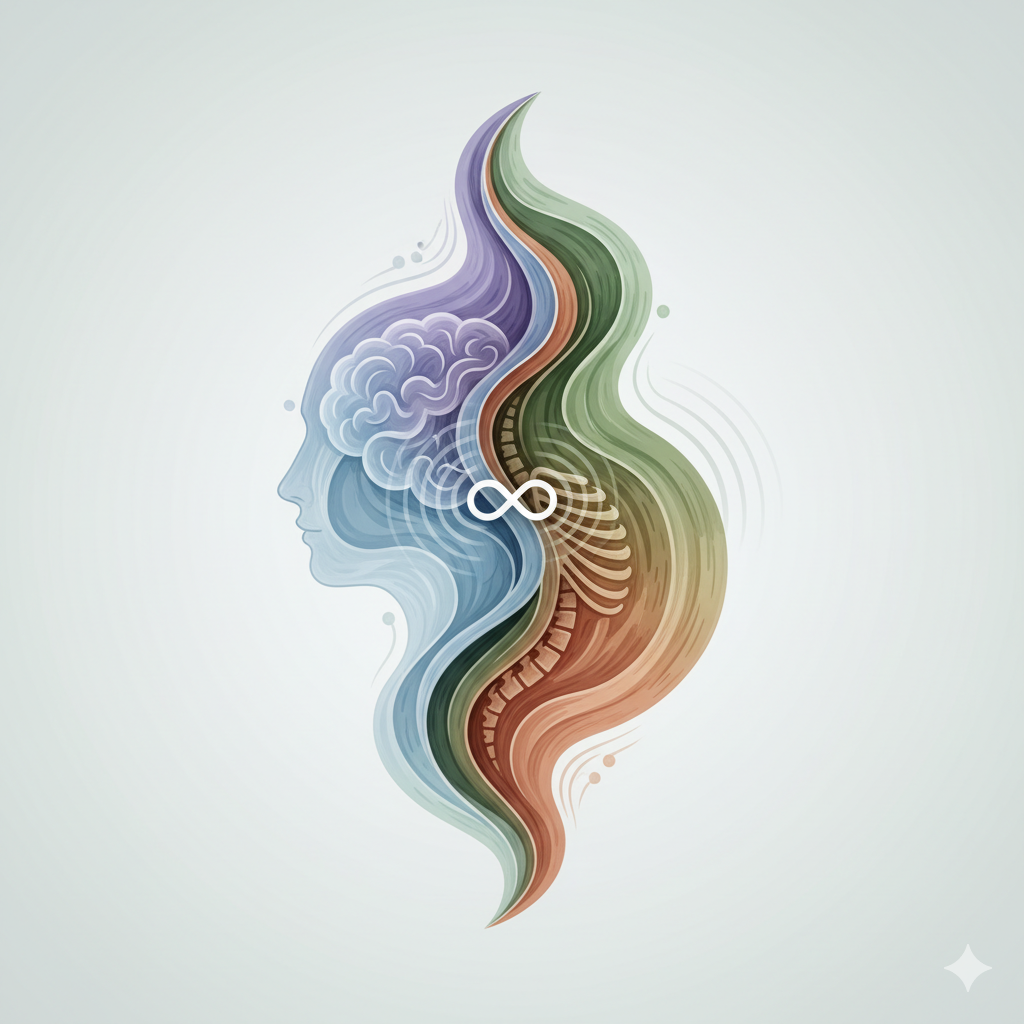
We frequently hear the phrase, "Mind and body are connected." Yet, I find this assertion rather peculiar. It suggests that the unseen "mind" and the visible "body" are first separated in thought, and then described as being connected. To me, it seems an unnecessarily complex act of deliberately splitting a single entity only to then piece it back together.
Today, many tend to conceptualize "mind" and "body" as distinct entities. However, as the Japanese word "mi" (身) for "body" inherently implies, our ancestors once encompassed both mind and body to express the entirety of life itself.
The Genesis of Separating Mind and Body
So, why did we begin to differentiate between mind and body? A significant factor lies in how the brain comprehends information.
The brain's mechanism for understanding can be likened to a wine bottle. A wine bottle has a narrow opening and a wide interior, with the constricted entrance often referred to as a "bottleneck." The brain's processing of information can be compared to pouring something into this bottle: only what passes through the bottleneck can truly be comprehended. Conversely, anything that cannot navigate this narrow passage remains beyond our grasp.
For instance, while attempting to explain the entire universe seems daunting, describing Earth, carved out from the cosmos, feels somewhat manageable. Further, detailing Japan, separated from Earth, or even Mount Fuji, a smaller segment still, becomes even more feasible. Vast concepts, in this way, cannot pass through the bottleneck and thus remain incomprehensible. Therefore, it is the brain's inherent design to divide grand concepts into smaller, more digestible components in order to achieve understanding.
Language, I often find, holds fascinating nuances. The Japanese words for "to divide" (分ける) and "to understand" (分かる) share the same root character. Grand concepts become comprehensible only through division; in other words, what cannot be divided remains unknowable. Returning to the question of why we began to separate mind and body: I believe it stemmed from our desire to comprehend our own existence. Since the brain struggles to grasp life in its entirety, we perhaps segmented it into the unseen mind and the visible body. As civilization progressed, we discovered the body's intricate framework of bones, organs, and physiological phenomena, leading to the development of disciplines like "Anatomy" and "Physiology." Today, we delve into even more fragmented fields, studying "cells" and "genes." Academia, in essence, is the division of vast concepts. The more academic fields advance, the greater the degree of compartmentalization. In modern society, those capable of dissecting concepts are often lauded as "intelligent." This very process helps us understand why the notion that medicine (as an academic field) reduces illness is an illusion; instead, the number of diseases continually proliferates. While contemporary estimates suggest there are over 100,000 types of illnesses, I suspect that in prehistoric times, ailments were simply categorized as "stomachache," "injury," or "fever."
The Dual Edge of Division: The Merits and Pitfalls of Specialization
Ancient wisdom purportedly stated, "Through division, names sicken (悩む - suffer)." This implies that that "as we divide, our afflictions multiply." Taking the earlier example of medicine, discomforts that were once categorized into a mere handful of types in ancient times are now fragmented into over 100,000 distinct illnesses. This proliferation suggests a corresponding increase in individuals suffering from these specific conditions. While academic advancement (specialization) undoubtedly offers benefits, it is equally true that our collective anxieties and struggles have escalated.
The Limits of Specialization and the Shift Towards Holism
Driven by a desire to comprehend life in its totality, we have divided mind from body, fostered academic disciplines, and continually fragmented knowledge. Yet, can we truly grasp the entirety of life simply by understanding all these specialized fragments? Aristotle, and subsequently Gestalt therapy influenced by him, posited that "the whole is greater than the sum of its parts." Accumulating all the components of a clock does not make it functional until assembled. Similarly, gathering all the elements that constitute our life does not spontaneously give rise to life itself. This underscores the profound truth that "the whole is not merely an aggregation of its parts."
The current emergence of the idea that "mind and body are connected" likely stems from a growing realization that solutions to our escalating troubles cannot be found within the prevailing paradigm of specialization. We may be at a pivotal moment, shifting from a trajectory where division amplifies distress towards one that embraces wholeness. This transition is articulated through terms like "holistic" and "holotropic." It signifies a move away from a world overly reliant on "understanding" to one that values "feeling." This is because, as we approach the whole, we must allow for an expanding realm beyond the brain's capacity to conceptualize. It may represent a crucial step towards perceiving the world more multifacetedly through our senses, liberating us from a realm where adherence to rigid principles and a belief in singular answers create suffering.
The Unfolding Bodywork Perspective: "Mind is Body, Body is Mind"
At Unfolding Bodywork, we do not view mind and body as separate entities. Instead, we perceive them as a singular, holistic life force. To achieve this, we harness the body's inherently sophisticated sensors. Through somatic sensations, we attune ourselves to the client's entire being. We intuitively absorb the information expressed by the whole self, and from this, thoughtfully construct each session. By embracing the understanding that "mind is body, body is mind," we recognize that a client's physical state profoundly reflects their mental and emotional landscape. This approach allows us to move beyond merely focusing on symptoms and their causes, instead empowering us to support the individual in achieving optimal well-being as a complete life system. While symptoms may naturally diminish as a result, the ultimate goal is not simply eradication of symptoms, but rather the harmonious unfolding of the entire self.