
Observe the illustration below. Four individuals stand in a row. As you contemplate each figure, what subtle sensations or impressions emerge within you?
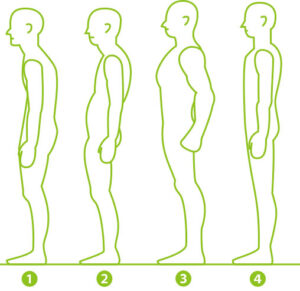
Do you perceive a slouched back? A muscular physique?
An individual embodying 'good' posture, and another 'poor' posture?
Is this the lens through which you observe them?
Such a perspective stems from merely observing the physical form of each posture and subjecting it to intellectual judgment.
Therefore, I pose the very same inquiry once again.
As you compare each individual, what sensations stir within you?
Should your perception remain confined to the classifications of 'good' and 'bad' posture, let us revisit these figures, inviting a more associative and intuitive gaze.
What essence does individual ① embody? What personality traits or habitual inclinations might they possess? Let your imagination roam freely, without concern for factual accuracy. If this proves challenging, consider a comparison between ① and ③. What distinctions in character might you intuit?
At Unfolding Bodywork, we refrain from judgment based solely on outward appearance or posture. Labels such as a 'hunched back' or 'distorted alignment' merely represent an intellectual judgment of a fragment of the physical form, itself a part of the greater tapestry of life. This superficial assessment fails to truly perceive the client; it offers no solution to the underlying issues they carry. We prioritize the felt sense over analytical judgment. This exercise serves to illustrate how we cultivate such a deeper perception.
Consider, for instance, the first individual, ①.
There is an impression of a lack of core engagement in their abdomen. Furthermore, they appear acutely sensitive to the scrutiny of others. While they likely harbor many unspoken thoughts, it feels less like active suppression and more like a gentle resignation. Their voice might be soft, their articulation perhaps indirect. A certain rigidity in their back suggests shallow respiration. They may be an attentive listener, yet reluctant to share their own narratives.
Now, let us turn our attention to the second individual, ②.
This individual, too, conveys a sense of disengagement in the abdomen, though their circumstance appears distinct from ①. A perceived heaviness in the lower back suggests a less active disposition. Moreover, a constriction in the throat hints at a profound suppression of unspoken sentiments, perhaps indicating a build-up of unexpressed frustration.
Proceeding, let us observe the third individual, ③.
Their voice projects loudly and articulately. While they may present an air of self-assurance, an underlying current suggests a potential lack of true confidence. Appearance likely holds significance for them, with a discernible affinity for beauty and elegance. They appear action-oriented, tending to move swiftly rather than lingering in contemplation.
And what of the fourth individual, ④?
While their posture might be perceived as ideal, their demeanor suggests a serious disposition. They exhibit proficiency in maintaining equilibrium and appear to adhere to established routines. Furthermore, they seem to embody a cautious temperament, disinclined towards adventurous pursuits.
Allowing your imagination free rein will undoubtedly reveal a myriad of other perspectives. This is an exercise in association, so the objective truth remains elusive. Yet, does it not resonate with a certain intuitive reality? For instance, it would be highly improbable to perceive individual ② as 'active' and individual ③ as 'inactive'.
While our immediate inclination is often to defer to rational thought, we have, throughout our lives, sensually accumulated a vast repository of information. That 'intuitive hunch' or 'felt sense' frequently proves remarkably accurate.
At Unfolding Bodywork, we hone this sensory perception through dedicated practice, allowing us to grasp the totality of life. In doing so, we gain access to a wealth of information far exceeding what can be gleaned from merely intellectually labeling someone with a 'hunched back'.
Whereas intellectual judgment often reaches a dead end, cultivating sensory perception progressively reveals the intricate narrative of a client's life. This clarity, in turn, illuminates precisely how to approach the body during a session.